


An unexpected Google Photos reminder brought back memories of two unforgettable San Francisco street performers, Larry “The Bucket Man” Hunt and Edward Jackson. One has passed away, while the whereabouts of the other remain a mystery.
By Miles J. Edwards | A.T.L. N.E.W.S. California Bureau
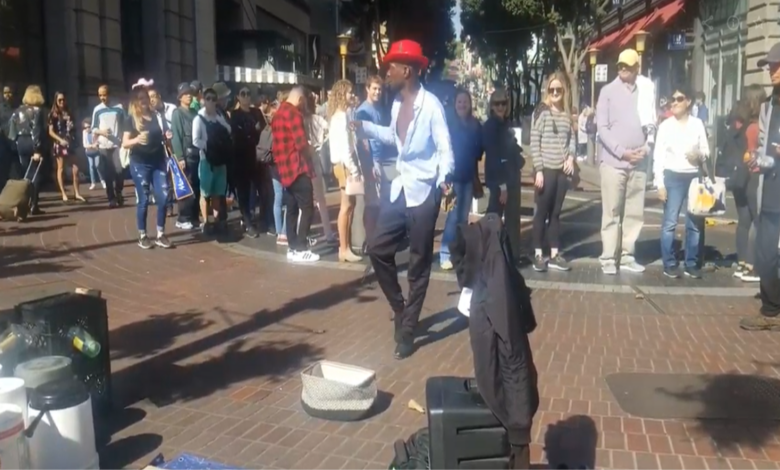
SAN FRANCISCO, Calif. — Sometimes, an unexpected reminder can take us back to a place, a person or a moment we hadn’t thought about in years. Recently, Google Photos brought one of those moments back to me when it resurfaced a video I recorded on October 26, 2019, featuring Edward Jackson, a San Francisco street performer whose remarkable tap-dancing skills had entertained residents and visitors for years. What began as an ordinary notification became a journey through memories of my time living in the Bay Area and the personalities who helped make San Francisco such a distinctive city.
Watching Jackson perform again prompted me to search through years of photographs and recordings, rediscovering moments from a period of my life when San Francisco was home. Among those memories was another unforgettable street performer, Larry “The Bucket Man” Hunt, whose extraordinary ability to transform ordinary household buckets into musical instruments made him one of the city’s most recognizable personalities. Although their talents were different, both men represented a creative spirit that could be found throughout downtown San Francisco, where sidewalks became stages and passing pedestrians became audiences.
The experience also brought back a sad discovery I made during my last visit home to San Francisco. Larry, whose performances had become part of the city’s cultural landscape, had died in 2023. While his passing has been publicly documented, I have been unable to determine what happened to Edward Jackson, whose current whereabouts remain unknown to me. The contrast between those two circumstances has made this unexpected Google Photos memory more meaningful, reminding me how easily the stories of people who contribute to our communities can fade from public attention.
The Performers Who Made San Francisco Their Stage
San Francisco has long been celebrated for its cultural diversity, artistic expression and unconventional personalities. While visitors often associate the city with cable cars, the Golden Gate Bridge, Fisherman’s Wharf and its historic neighborhoods, some of its most memorable attractions have been the individuals who bring music and entertainment directly to the streets. Street performers have helped shape the atmosphere of public spaces throughout the city, creating spontaneous experiences that connect residents, tourists and people from different backgrounds.
Larry Hunt was among those performers whose presence became familiar to generations of people traveling through downtown San Francisco. Known affectionately as “The Bucket Man,” Hunt developed a distinctive percussion style using plastic buckets, pots, pans and other everyday objects to create energetic musical performances. His ability to produce complex rhythms from unconventional instruments attracted crowds and helped establish him as a recognizable figure along the Market Street corridor. For Hunt, the streets were more than a place to entertain; they provided a livelihood and an opportunity to share his musical abilities with the public.
Edward Jackson brought a different artistic tradition to the same environment, using tap dancing to create rhythms that complemented the sounds of the surrounding city. His performances transformed ordinary sections of pavement into makeshift stages, demonstrating the precision, timing and physical endurance required of an accomplished tap dancer. Jackson’s ability to entertain audiences through movement and percussion made him another memorable presence in San Francisco’s street-performance community, particularly in areas frequented by visitors and downtown workers.
During my years living in San Francisco, I had opportunities to document performers and other individuals whose personalities contributed to the city’s character. Among my recordings are videos dating back to January and March 2017, along with the October 26, 2019, recording of Jackson that recently resurfaced through Google Photos. At the time, I was simply capturing moments that interested me, without anticipating that those recordings might eventually become part of a larger reflection on the people and cultural experiences that helped define my time in the city.
Video: San Francisco street performer Edward Jackson demonstrates his tap-dancing skills in footage recorded October 26, 2019, by Miles J. Edwards. The recording resurfaced through Google Photos and inspired this retrospective feature.
From San Francisco Sidewalks to Hollywood and National Advertising
Although Hunt and Jackson became familiar faces through their performances on San Francisco’s sidewalks, their talents also attracted attention beyond the Bay Area. Both performers demonstrated that artists working in public spaces could achieve recognition through mainstream entertainment and advertising without abandoning the creative environments where they developed their reputations.
For Hunt, one of his most notable appearances came in the 2006 motion picture The Pursuit of Happyness, starring Will Smith and his son, Jaden Smith. Based on the experiences of entrepreneur Chris Gardner, the film follows a struggling father confronting homelessness while pursuing an opportunity to build a better future for himself and his young son. Hunt appeared in the film as a bucket drummer, bringing an authentic element of San Francisco’s street culture to a Hollywood production filmed in the city where he had become a recognizable performer.
Hunt’s talents also reached national television audiences through an appearance on America’s Got Talent, further demonstrating the appeal of his unconventional approach to percussion. His performances challenged traditional assumptions about musical instruments and professional entertainment, showing how creativity and determination could transform ordinary objects into tools of artistic expression. Although his performances were often associated with the city’s tourist areas, his recognition extended beyond those locations and introduced viewers elsewhere in the country to a distinctive part of San Francisco’s cultural identity.
Jackson also received recognition through commercial advertising when he appeared in an Intel advertisement highlighting his tap-dancing abilities. The commercial showcased the skill and creativity that had made him a familiar performer on San Francisco’s streets, while also providing a visual connection to Hunt. At approximately one minute and 37 seconds into the video, Larry can be seen playing his buckets in the background, bringing the two artists together in a production that introduced their talents to a broader audience.
Their professional connection was not limited to the commercial. In January 2000, the San Francisco Chronicle documented Hunt and Jackson performing together at Fourth and Market streets under the name “Beat With the Feet.” Their collaboration combined bucket percussion with tap dancing, creating a performance in which both artists contributed to the rhythm through their respective instruments. One produced music with buckets and drumsticks, while the other created percussion through the movement of his feet, illustrating how two different artistic traditions could complement one another.
Rediscovering these connections has given me a greater appreciation for the performers I encountered during my years in San Francisco. They were not simply individuals entertaining pedestrians for spare change, but working artists whose talents had been recognized by major entertainment and advertising productions. Their accomplishments also demonstrate why the contributions of street performers deserve consideration when documenting a city’s cultural history.
More Than Entertainment: Defending Their Right to Perform
While Hunt and Jackson were known for entertaining audiences, their experiences also reflected the challenges faced by artists who depend on public spaces to earn a living. Street performance has long been part of San Francisco’s identity, but performers have frequently encountered disputes involving businesses, residents, public officials and regulations governing entertainment in shared spaces. These conflicts raise questions about how cities balance commercial activity, pedestrian access and artistic expression while protecting opportunities for independent performers.
Both men participated in discussions about the future of street entertainment in San Francisco. On May 5, 2015, Hunt and Jackson addressed the San Francisco Entertainment Commission during a meeting involving issues affecting street performers. Their participation demonstrated that the musicians and dancers who contributed to the city’s public atmosphere were also workers with legitimate concerns about their livelihoods and the regulations affecting their ability to perform.
Their advocacy remains relevant as cities across the country continue examining the role of street entertainment in downtown revitalization and public life. Performers contribute to the cultural atmosphere that attracts visitors and encourages pedestrian activity, yet their economic contributions are not always acknowledged in broader discussions about tourism and development. Hunt and Jackson represented a community of artists whose work illustrated the connection between creative expression, economic opportunity and the character of urban neighborhoods.
The News I Didn’t Expect
During my last visit home to San Francisco, I learned that Larry “The Bucket Man” Hunt had passed away in February 2023 at the age of 64. His death marked the loss of a performer whose music had become part of the city’s everyday experience and whose determination had earned recognition from audiences far beyond the Bay Area. On March 25, 2023, friends, fellow musicians and admirers gathered for a musical procession through downtown San Francisco to celebrate his life and contributions to the community.
Learning of his passing made me reflect on the individuals who become familiar parts of our surroundings, even when we do not maintain personal relationships with them. We may encounter the same musician, artist or neighborhood personality repeatedly over the years, gradually associating their presence with a particular place or experience. When those individuals disappear from the places where we remember seeing them, their absence can represent more than the loss of a familiar face; it can also signal the passing of a small but meaningful part of a community’s identity.
Having moved away from San Francisco, I no longer experience many of the sights and sounds that once formed part of my daily surroundings. Returning to the city brings opportunities to reconnect with familiar places, but it also reveals how much has changed during my absence. Discovering that Hunt had died was one of those reminders, particularly because his performances had been such a recognizable element of the downtown environment I remembered.
But Where Is Edward Jackson?
While Hunt’s death has been publicly documented, the circumstances surrounding Edward Jackson’s present life remain unclear to me. The October 26, 2019, recording confirms that I encountered him performing in San Francisco that year, but I have been unable to locate reliable, recent information establishing whether he continues performing, has retired or has relocated elsewhere. I also have not found verified information indicating that he has passed away, making it important to distinguish his unknown whereabouts from Hunt’s confirmed death.
Jackson’s contributions to San Francisco’s street-performance culture deserve recognition regardless of where life may have taken him. His years of entertaining audiences, his documented collaboration with Hunt and his appearance in a national advertising campaign demonstrate that his work extended beyond individual sidewalk performances. His story also reflects the experiences of many independent artists whose contributions become part of a city’s identity without necessarily receiving the sustained documentation afforded to performers working in more conventional entertainment industries.
I hope that publishing this remembrance might help reconnect with people who remember Jackson or have information about his current whereabouts. Former fellow performers, longtime San Francisco residents, friends or family members may be able to provide additional details about his life and career. More importantly, I would welcome an opportunity to speak with Jackson himself, if he is available and interested, to learn more about his experiences and the changes he witnessed during his years performing in the city.
A City Is More Than Its Buildings
San Francisco has undergone significant changes over the years, particularly in its downtown neighborhoods, where shifts in business activity, tourism, housing and public life continue to reshape the urban landscape. Familiar businesses have closed, new developments have emerged and public spaces have evolved alongside the economic and social challenges confronting the city. These changes often dominate discussions about San Francisco’s future, but they also raise questions about preserving the cultural experiences that have historically made the city distinctive.
A city’s identity cannot be measured solely through its skyline, major employers, famous landmarks or economic achievements. It is also shaped by the people who contribute to everyday life, including artists, musicians, dancers and other individuals whose work creates memorable experiences in public spaces. Performers like Hunt and Jackson helped transform ordinary sidewalks into places of entertainment and human connection, providing moments that residents and visitors could carry with them long after leaving the city.
Their contributions may not always receive the recognition associated with established cultural institutions, but they remain part of San Francisco’s history. Preserving those stories requires looking beyond traditional accounts of prominent figures and major events to recognize the individuals whose creativity helped define the character of neighborhoods and public gathering places. The recordings, photographs and personal recollections that people preserve can become valuable records of those contributions, particularly as cities and their communities continue to change.
When Google Reminds You of Yesterday
That unexpected Google Photos notification reminded me why documenting people and communities has always been important to my work. When I recorded Edward Jackson performing on October 26, 2019, I had no reason to believe that the footage would eventually inspire a retrospective about two San Francisco street performers. It was simply a moment I wanted to capture, one of many experiences that became part of my personal archives during my years living in the city.
Years later, that recording has taken on a different meaning. It has encouraged me to revisit the contributions of two artists whose performances were part of San Francisco’s cultural landscape, while also reminding me of the importance of preserving stories that might otherwise disappear with time. Larry Hunt’s death makes those memories especially poignant, while the unanswered questions surrounding Edward Jackson provide an opportunity to continue learning about a performer whose talents deserve recognition.
As A.T.L. N.E.W.S. continues developing its California Bureau and expanding coverage of communities across the country, stories like these reflect the purpose behind our commitment to local journalism and cultural storytelling. Every community has individuals whose experiences contribute to its history, and those contributions deserve attention regardless of whether the people involved achieve widespread fame or recognition.
Sometimes, the stories worth preserving are not discovered through major news events or carefully planned interviews. They emerge from ordinary encounters, personal memories and the unexpected rediscovery of moments we once considered routine. In this case, a simple reminder from Google Photos brought me back to the San Francisco I remember and encouraged me to share the stories of two performers who helped make that experience unforgettable.
In Loving Memory of Larry “The Bucket Man” Hunt
1958–2023
Rest in Paradise, Larry.
Your music, your spirit and the rhythms you brought to the streets of San Francisco will forever be part of the city’s memories.
Short Doc by : Pillow Talk Productions
Created By: Tracy Spohn and Bia Roldan
Help Us Find Edward Jackson
A.T.L. N.E.W.S. California Bureau welcomes information from individuals familiar with Edward Jackson and his years performing in San Francisco. Anyone with memories of his performances or verified information about his current whereabouts is encouraged to contact ca********@*tl.news. We would welcome the opportunity to learn more about his story and, if possible, speak with him directly.
Original archival footage: Miles J. Edwards / A.T.L. N.E.W.S.
Historical references include the San Francisco Chronicle, San Francisco Entertainment Commission records, The Pursuit of Happyness (2006), and Intel’s “Edward Jackson: Performer” advertisement.