


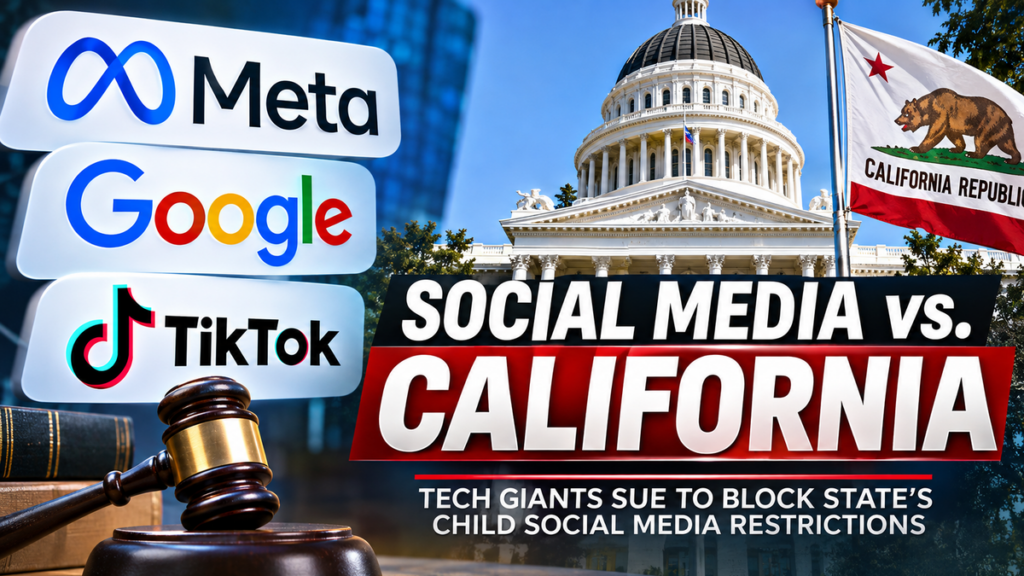
Meta, Google and TikTok challenge California’s latest attempt to regulate social media platforms, arguing that restrictions intended to protect children violate constitutional free-speech protections.
By A.T.L. N.E.W.S. | California Bureau
SAN FRANCISCO, Calif. — Three of the world’s largest technology companies have launched a legal challenge against the state of California, setting the stage for another major confrontation over children’s online safety, parental authority and the constitutional rights of social media platforms. Meta, Google and TikTok filed separate federal lawsuits Wednesday, November 4, seeking to prevent California from enforcing a new law that restricts social media features considered potentially addictive for children younger than 16.
The lawsuits target Assembly Bill 1709, legislation signed by California Governor Gavin Newsom on September 10, 2026, and scheduled to take effect January 1, 2027. The law prohibits covered social media platforms from offering certain features to children under 16 that lawmakers describe as psychologically exploitative, including personalized content recommendations and automatic video playback. The legislation also requires platforms to remove accounts belonging to children that continue using the prohibited features, creating substantial compliance challenges for companies whose business models depend heavily on personalized content delivery.
At the center of the dispute is a fundamental question about the government’s authority to regulate how technology companies design and distribute online content. California lawmakers maintain that the restrictions are necessary to address concerns about compulsive social media use among children, while the companies argue that the state is attempting to exercise unconstitutional control over how platforms organize and present information to their users.
Technology Companies Challenge California’s Authority
Meta, the parent company of Facebook, Instagram and Threads, filed its lawsuit in federal court in San Francisco. Google, which owns YouTube, filed its challenge in San Jose, while TikTok brought its case in Los Angeles. All three companies argue that the legislation violates the First Amendment’s protections for freedom of speech and conflicts with Section 230 of the federal Communications Decency Act, which provides important legal protections for online platforms concerning third-party content.
The companies contend that decisions about recommending videos, organizing feeds and presenting user-generated material constitute editorial judgments protected by the Constitution. Meta argues that California cannot substitute its own preferences for the company’s decisions about how billions of posts are selected and displayed. Google maintains that broad restrictions could interfere with systems designed to help younger audiences discover educational and age-appropriate material, while TikTok argues that lawmakers cannot prohibit access to otherwise lawful expression simply because they consider certain content unsuitable for children.
The legal challenge also raises questions about parental authority. The companies maintain that parents, rather than state officials, should have primary responsibility for deciding which social media features their children can access. TikTok specifically argues that the legislation would prevent parents from authorizing personalized recommendations even when they have activated parental controls, restricted content and established daily screen-time limits.
Industry advocates have joined the opposition. NetChoice, a technology trade association involved in several legal challenges to state social media regulations, publicly supported the lawsuits, arguing that California’s restrictions interfere with constitutionally protected editorial decisions. The organization maintains that existing parental controls and age-appropriate settings provide families with alternatives to broad government restrictions.
California Defends Its Efforts to Protect Children
California officials view the legislation as part of a broader effort to address growing concerns about the relationship between social media use and children’s mental health. Supporters of the law argue that certain platform features are designed to encourage prolonged engagement, making it difficult for young users to disengage from online content even when they intend to stop.
Assembly Bill 1709 was introduced by Assemblymember Josh Lowenthal, a Democrat representing the Long Beach area, who has pointed to concerns about anxiety, depression and compulsive technology use among children. Features such as autoplay and algorithmically generated recommendations have attracted particular scrutiny because they can continuously deliver additional material without requiring users to make deliberate choices about what to view next.
When Newsom signed the legislation in September, he emphasized the state’s responsibility to address potential risks associated with children’s exposure to digital technology. The governor’s administration has supported multiple measures intended to strengthen protections for young internet users, placing California among the states pursuing more aggressive regulation of social media companies.
California Attorney General Rob Bonta is the defendant named in the lawsuits because his office is responsible for enforcing the legislation. Following the filings, his office said it was reviewing the legal challenges and remained committed to defending California’s child-protection laws.
The litigation does not establish that the law is unconstitutional, nor does the filing of a lawsuit automatically suspend its enforcement. Unless a court intervenes, Assembly Bill 1709 remains scheduled to take effect at the beginning of 2027.
A Growing Legal Battle Over Social Media and Young Users
The latest lawsuits are part of a larger national conflict involving social media companies, lawmakers, parents and public-health advocates. Across the United States, state governments have introduced legislation addressing age verification, personalized recommendations, parental consent, privacy protections and other aspects of children’s online experiences.
California has already faced legal challenges over Senate Bill 976, another measure intended to restrict addictive social media feeds and certain platform features for minors without parental consent. The relationship between that law and Assembly Bill 1709 has become another point of contention, particularly because the newer legislation imposes restrictions that the technology companies argue cannot be waived through parental permission.
At the same time, social media companies face substantial legal exposure from lawsuits alleging that their platforms were deliberately designed to encourage compulsive use and contributed to mental-health problems among young people. Those proceedings involve different legal questions from the companies’ challenges to California’s regulatory authority, but together they demonstrate the increasingly complex legal environment surrounding the technology industry.
The debate also extends beyond the companies and state governments. Digital-rights advocates have raised concerns that sweeping restrictions could interfere with lawful expression, require intrusive age-verification systems or limit young people’s access to educational and community resources. The Electronic Frontier Foundation has criticized California’s approach on privacy and free-speech grounds, illustrating that opposition to the legislation is not limited to the companies directly affected by it.
What the Lawsuits Could Mean for Parents and Families
For parents, the outcome could determine how much authority states have to restrict the features children encounter on major social media platforms. If California successfully defends its law, covered companies could be required to make significant changes to the experiences they offer users younger than 16. Those changes could affect how children discover videos, receive recommendations and interact with services that have become part of everyday communication and entertainment.
A ruling in favor of the technology companies, meanwhile, could limit the ability of California and other states to regulate certain aspects of social media design when those features involve selecting, organizing or displaying protected speech. Such a decision would not necessarily prevent governments from pursuing other child-safety measures, but it could influence how future legislation is written and enforced.
The dispute also highlights an unresolved policy question: whether restrictions on specific technological features can effectively reduce harmful or compulsive use without unnecessarily limiting access to useful information. Personalized recommendations can expose young audiences to educational content, creative opportunities and supportive communities, but critics argue that the same systems can encourage excessive engagement or repeatedly direct users toward material they did not actively seek.
For families, the immediate situation remains unchanged by the filing of the lawsuits. Parents can continue using available parental controls, screen-time settings and content restrictions while the courts consider the challenges.
California’s Decision Could Influence the Nation
Although the litigation is taking place in California, its implications extend far beyond the state’s borders. Meta, Google and TikTok operate platforms used by millions of Americans, and legal rulings concerning their content-recommendation systems could influence similar laws elsewhere.
California also occupies a particularly influential position in the technology industry. With major social media and technology companies operating throughout Silicon Valley and the San Francisco Bay Area, the state’s regulatory decisions can have consequences for companies, workers, advertisers, independent content creators and digital publishers nationwide.
For independent media organizations and creators who depend on social platforms to reach audiences, changes to recommendation systems could also affect how content is discovered and distributed. However, the precise consequences would depend on the final scope of the law, any court rulings and the methods companies choose to comply with future requirements.
The federal courts must now determine whether California’s effort to protect children from potentially addictive online features is consistent with constitutional protections governing speech and editorial discretion. The companies are seeking to block enforcement before the law’s scheduled January 1 effective date, making the coming weeks especially important for regulators, technology companies and families.
The outcome could help define how far states may go in regulating the design of social media platforms—and who ultimately has the authority to decide what children see when they go online.