


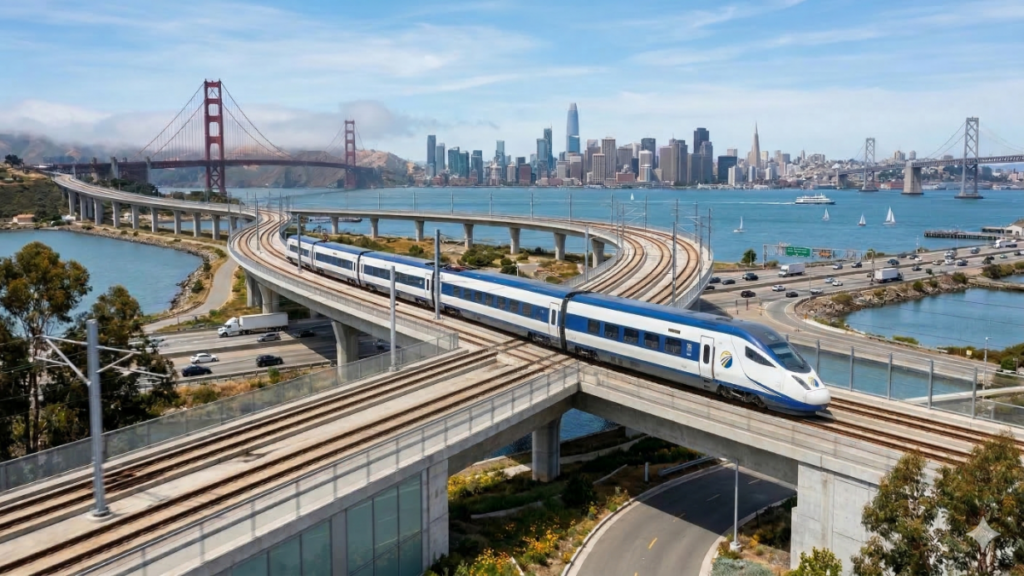
A Status Report on America’s First High-Speed Rail
SACRAMENTO, CA – The California high-speed rail project is finally moving from blueprints to physical reality. For years, critics debated the cost and scale of this “mega-project.” However, the spring of 2026 marks a major shift for the state’s transit future. The California High-Speed Rail Authority (CHSRA) recently released its 2026 Draft Business Plan, signaling a “right-sized” strategy to ensure passengers can board by the early 2030s. Construction is now active on over 119 miles in the Central Valley, with crews transitioning from heavy concrete work to actual rail installation.
Visible milestones are appearing across the valley. In February 2026, Governor Gavin Newsom celebrated the completion of the Southern Railhead Facility in Kern County. This 150-acre hub manages the massive quantities of steel and ballast required for the system. Following this achievement, the first high-speed tracks are scheduled for installation in September 2026. As of March, crews have finished 58 major structures, leaving nearly 80 miles of guideway ready for the next phase of development.
The updated 2026 Draft Business Plan introduces a leaner approach to combat inflation. This plan estimates the Phase 1 cost at $126.2 billion, a slight reduction from previous high-end projections. The state remains focused on the Initial Operating Segment (IOS), which connects Merced to Bakersfield. Service on this 171-mile stretch is targeted for 2032. To reach Los Angeles faster, the Authority is also using a “blended” strategy. This involves partnering with regional carriers like Metrolink to share electrified tracks and avoid the immediate need for expensive mountain tunnels.
Beyond transportation, this project serves as a massive economic engine for California. It has created over 16,400 jobs, with local residents filling roughly 70% of these roles. Additionally, the system will run on 100% renewable energy to remove millions of cars from the I-5 and SR-99 corridors every year. While some members of Congress still aim to cut federal funding, the state is doubling down on “Cap-and-Invest” revenue and private partnerships. California is betting that the sight of the first trains testing in 2028 will silence the critics for good.