


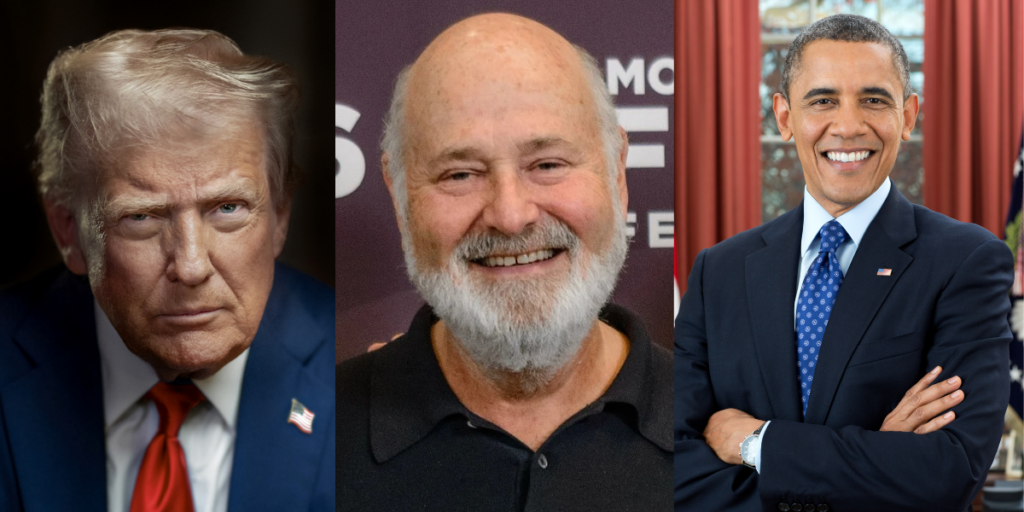
Obama’s grief‑stricken tribute honored Reiner’s legacy, while Trump’s “Trump Derangement Syndrome” broadside turned a homicide into another front in his long‑running culture war.
Hollywood, California – Rob Reiner’s killing has become both a criminal tragedy and a political mirror, revealing sharply different ideas of leadership in the reactions from Barack Obama and President Donald Trump. One response centered grief and legacy; the other turned a homicide into another front in a personal feud.
The killing and investigation
Rob Reiner, the acclaimed actor and director behind films such as “When Harry Met Sally…” and “A Few Good Men,” and his wife, producer Michele Singer Reiner, were found fatally stabbed in their Brentwood, Los Angeles, home on a Sunday afternoon. Los Angeles police classified the case as a homicide and arrested the couple’s 32‑year‑old son, Nick Reiner, who has been booked on murder charges and is being held on $4 million bail as prosecutors prepare formal counts. Authorities say they are not seeking additional suspects at this time and that the department’s Robbery‑Homicide Division is leading the investigation.
Obama’s tribute: grief and values
Former President Barack Obama was among the first major political figures to respond publicly, issuing a detailed statement on X. “Michelle and I are heartbroken by the tragic passing of Rob Reiner and his beloved wife, Michele,” he wrote, praising Reiner’s achievements in film and television for giving Americans “some of our most cherished stories on screen” and highlighting his “deep belief in the goodness of people—and a lifelong commitment to putting that belief into action.” Obama described the couple as having lived “lives defined by purpose,” saying they would be remembered for “the values they championed and the countless people they inspired,” and extended condolences “to all who loved them.”
Trump’s post: blame and grievance
President Donald Trump struck a starkly different tone in a Truth Social post and subsequent comments, quickly drawing bipartisan condemnation. Acknowledging the “very sad” deaths, Trump nevertheless declined to offer sympathies and instead claimed, without evidence, that Reiner and his wife died “due to the anger he caused others through his massive, unyielding, and incurable affliction with a mind crippling disease known as TRUMP DERANGEMENT SYNDROME,” a phrase he and his supporters use to suggest that critics are irrational or mentally unstable. He described Reiner as “a tortured and struggling, but once very talented movie director and comedy star,” accused him of having a “raging obsession” with Trump that “drove people crazy,” and later doubled down to reporters by calling Reiner “deranged” and “very bad for our country.”
Public and political backlash
Trump’s decision to frame Reiner’s killing around “Trump derangement syndrome” rather than around the loss of life triggered criticism from Democrats, Republicans, and commentators who said the president had politicized a murder and shown a lack of basic decency. Editorials and analysis pieces called the comments “vile,” “indefensible,” and “nauseating even by the president’s standards,” arguing that they fit a broader pattern of using moments of national shock to inflame grievance rather than express empathy. By contrast, Obama’s tribute circulated widely among entertainers, political figures, and fans as the tone‑setting public eulogy, emphasizing Reiner’s artistic legacy, moral commitments, and the shared sense of loss felt by those who saw their own values reflected in his work.